The Living Room Rug Guide: Get the Size Right First
Shopping note: This guide links directly to retailers. We do not earn a commission from these links. Read our disclosure. This is a research-based buying guide.
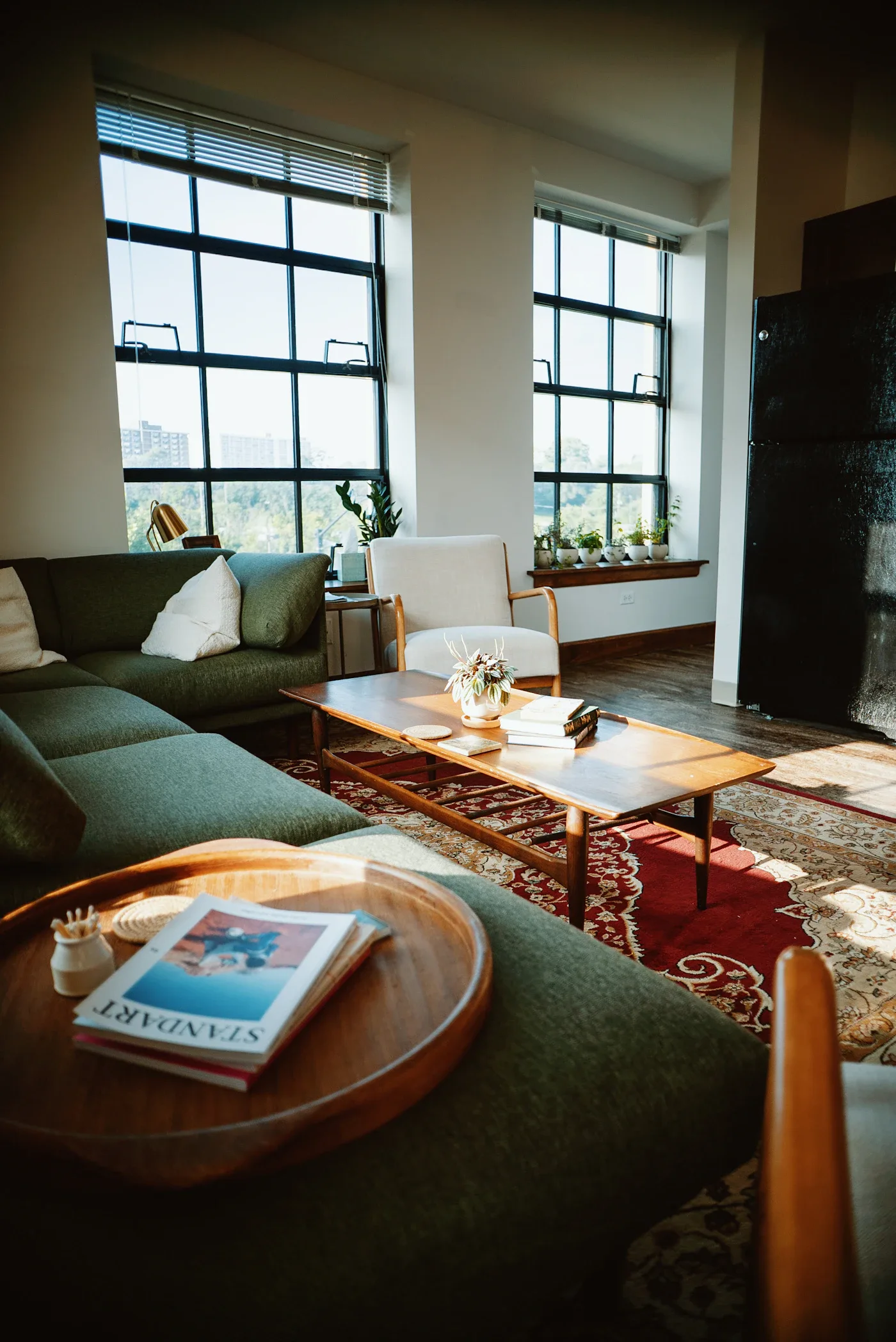
If the sofa and chairs feel disconnected, the rug may be defining only the coffee table. This is especially noticeable in an open-plan room, where a small rectangle floats between large pieces instead of bringing them together. Before shopping for a different pattern, check whether the rug reaches the seating.
The buying verdict: choose the layout first and the closest suitable rug dimensions second. For many living rooms, a rug that supports the front legs of the sofa and neighboring chairs is a useful starting point. Do not size up so far that doors, vents, or necessary floor transitions become awkward.
Map the seating group
Move the furniture into the arrangement you want to keep. Mark several possible rug outlines with floor-safe tape, including the actual retailer dimensions. Nominal sizes can be rounded, so read the individual listing.
Crate & Barrel's rug guide recommends a rug large enough to hold at least the front legs of the sofa and chairs. IKEA's seating-area rug guide also emphasizes a rug at least as wide as the sofa. These are useful design references, not a reason to ignore your room's shape.
Leave the tape down while you use the room. Check where chair feet land when someone sits, whether a recliner opens, and where a wheeled desk chair travels if the living room includes a work corner.
Choose the placement that suits the room
| Layout | When it works | Visual effect | Buying caution |
|---|---|---|---|
| Front furniture legs on the rug | Most sofa-and-chair groups | Connects the seats while showing surrounding floor | Ensure the sofa sits evenly and chairs do not rock |
| All furniture legs on the rug | A larger, clearly defined seating zone | Creates one generous room-within-a-room | Higher cost and more furniture to move for cleaning |
| Rug centered under a small conversation group | A compact pair of chairs or reading nook | Makes a distinct smaller zone | It should still relate to the chairs, not just a table |
| Layered accent rug over a larger base | A room where a favorite small rug needs context | Adds texture and pattern | Extra edges and thickness complicate stability and care |
Material comes after the footprint
A plush surface can feel appealing in a room used for floor play, but consider vacuuming, furniture movement, and any door that passes over it. A flatter construction can be easier under movable furniture, though softness varies considerably by product.
For a household with frequent spills, compare the actual cleaning method. “Easy care,” “stain resistant,” and “machine washable” describe different things. If the rug is washable, check the required machine capacity and drying instructions for that exact size. A rug that requires equipment you do not have is a different ownership decision.
Natural fiber, wool, and synthetic rugs each include a wide range of constructions. Avoid choosing by fiber name alone. Read the backing information, pile description, care instructions, and floor-compatibility guidance.
The pad belongs in the budget
Check whether the rug requires a separate pad and which pad the seller recommends for your floor. The combined thickness matters at doors and transitions. Trim a compatible pad as directed rather than letting it protrude beyond the rug.
Do not assume every nonslip backing is suitable for every finish. A floor manufacturer's restrictions should be part of the purchase check, especially on a newly installed or refinished floor. An attractive rug is not worth a preventable compatibility problem.
What not to overpay for
The usual false economy is buying the smaller size because it makes the preferred pattern affordable, then replacing it when the room still feels wrong. Compare simpler designs in the correct size before shrinking the footprint.
At the other extreme, do not pay for a larger size that disappears under every cabinet or interferes with a natural walkway. Pay for appropriate dimensions and practical construction before a designer name. Photograph your taped outlines from the doorway; the difference is often easier to judge from that view.
Coordinate the rug with your sofa plan before purchasing either piece. A deep chaise can change the required shape more than a change in sofa color ever will.
Common questions
Does the rug need to reach the TV stand?
Usually the seating group is the more useful reference. The media console can remain outside the rug when the arrangement still feels balanced and the edge does not create an awkward transition.
Can I use a round rug with a rectangular sofa?
Yes, but map how the curve meets the sofa and chairs. A circle's advertised diameter can hide how little coverage remains near its edges.
Should the rug be centered in the room?
Center it on the activity zone when the room has several functions. In an open-plan space, the living-room rug does not need to align with the center of the entire floor plan.
Sources and shopping references
Sources checked October 9, 2026. Final dimensions should follow your measured layout and the selected product listing.
Check the details before you buy.
Compare current dimensions, materials, care instructions, and return terms at the retailer.